
Foreign Artist Accused of Copying Korean Photographer’s Work, Renewing Plagiarism Debate
SEOUL — A recent claim that a foreign artist copied the work of a Korean photographer has reignited debate surrounding plagiarism in the global art world.
While past controversies in Korea largely centered on domestic creators allegedly copying foreign works, recent years have seen the opposite — foreign artists accused of reproducing Korean artists’ images without permission. The trend is being interpreted as both a sign of growing global recognition of Korean creative work and a reminder that in a hyper-connected era, plagiarism is increasingly difficult to conceal.
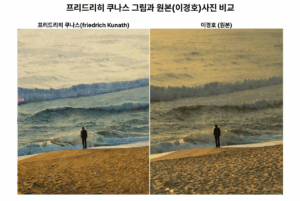
Photographer and videographer Lee Kyung-ho told Yonhap News Agency on November 14 that a painting showcased by Friedrich Kunath, an artist represented by Pace Gallery, appears to be a traced reproduction of one of his photographs. According to Lee, the painting was shown at Kunath’s solo exhibition in New York.
Lee claims Kunath’s image matches his photograph “almost identically,” describing the resemblance as “tracing-level copying.” He said he first became aware of the situation when a photo of Kunath’s work circulated on social platform Threads earlier this month.
“This incident was shocking enough that I felt I could not simply overlook it,” Lee wrote on his Threads account, adding that he plans to respond carefully and firmly after confirming details.
Online users have joined the discussion, with many expressing support.
One Threads user wrote, “The artwork I really liked turns out to be copied from a Korean photographer. The resemblance is undeniable.”
Another commented, “Artistic borrowing should be allowed to a point, but this looks like plagiarism.”
However, Lee stated in a phone interview on November 24 that he has not yet confirmed whether Kunath intentionally copied the work. “I need to verify the circumstances first. It would be better to speak publicly once everything is clarified,” he said.
Growing List of Overseas Plagiarism Claims
This is not the first time a Korean artist has claimed their work was copied abroad.
In 2023, Korean media reported that a Chinese retailer had reproduced and sold works by artist Hwang Seon-tae, known for LED-backlit drawings simulating sunlight and shadows.
In 2015, photographer Lee Myung-ho accused renowned fashion designer Mary Katrantzou of using elements of his work Tree…#3 without permission in her A–Z Collection. Katrantzou later issued a public apology and reached a settlement, and the disputed product was removed from online listings.
Another case occurred in 2019, when Korean illustrator Hong Soon-sang discovered that a character featured in Filipino author Chellet Gifa’s children’s book The Little Hero, presented at the Manila International Book Fair, was nearly identical to his own character design. Gifa later issued a public apology, and the publisher discontinued the book.
Cases in Korea of Alleged Plagiarism of Foreign Works
Conversely, allegations continue to arise against Korean creators copying overseas works.
In September, promotional posters for streaming platform TVING’s original series Dear X drew criticism for resembling visuals from the Chinese film The Devotion of Suspect X. TVING later acknowledged the issue and discontinued use of the poster.
In 2021, the official poster for the Jeonju International Film Festival was accused of copying Spanish design studio Hey Studio’s artwork Rebuild Japan. Although the festival denied plagiarism, the poster was replaced.
Other similar disputes include a 2019 poster for the MBC drama Love With Flaws, which was compared to visuals from Dua Lipa’s New Rules music video — a resemblance the production team defended as parody rather than plagiarism.
Legal Perspective
Attorney Koo Bon-jin, head of The Kim Law Firm, stated that plagiarism cases are typically evaluated based on two criteria: access and substantial similarity.
“Access refers to whether the accused had the opportunity to see the original work, and substantial similarity determines how closely the works resemble each other,” he explained. “Some courts assess these separately, while others evaluate them together.”
Koo noted that while Korea increasingly recognizes moral rights in copyright disputes, outcomes still vary depending on the judge.
“Recently, disputes involving Korean works being copied overseas have increased,” he added. “With the internet enabling real-time access to global artworks, the public is becoming far more sensitive and vigilant about plagiarism.”
https://www.yna.co.kr/view/AKR20251121022400505?input=1195m